

Creating is human
Honing a craft, whatever it takes, is just about as human as one can be

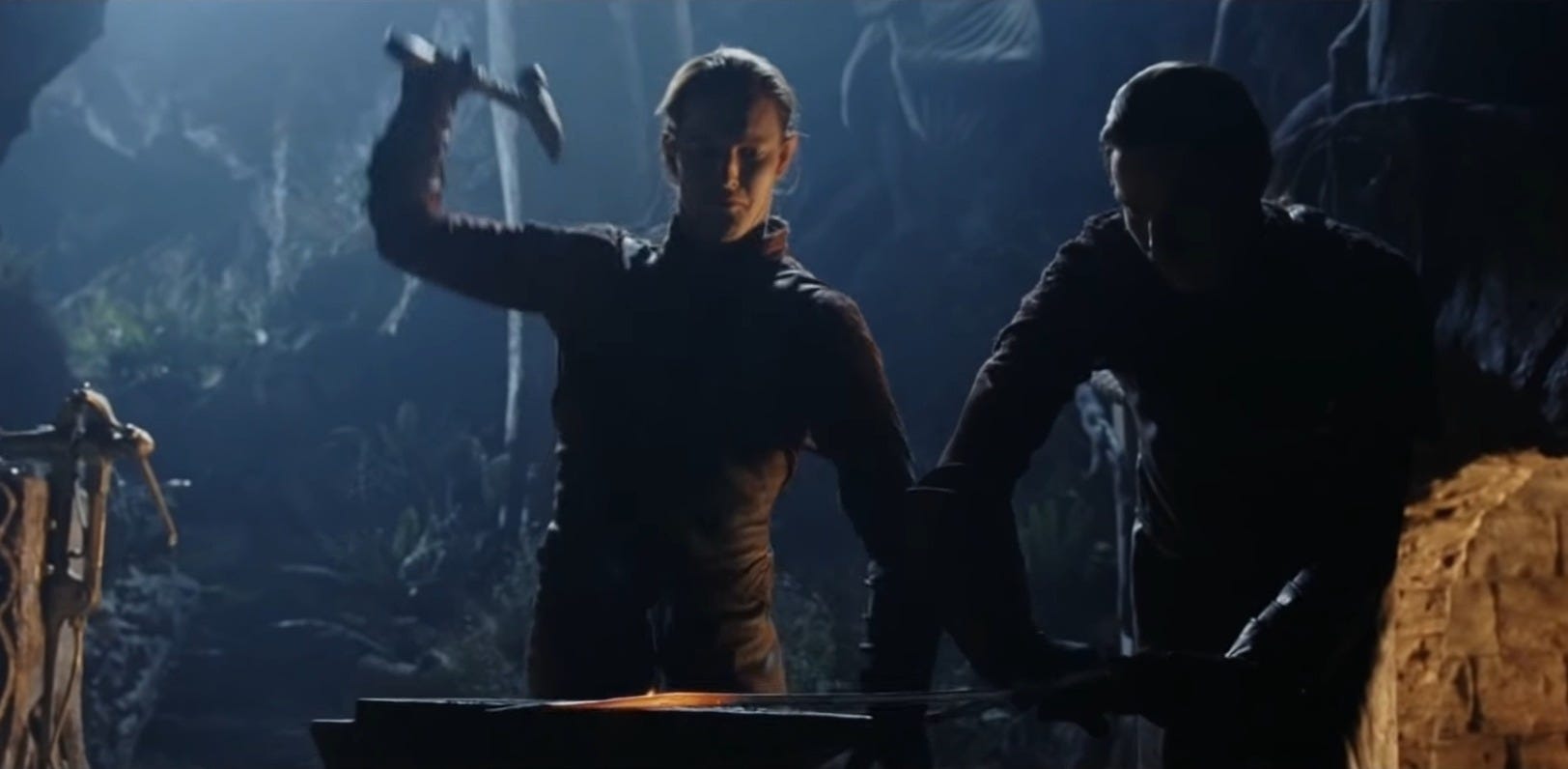
A few months ago, I read a wonderful piece from Blackbird Spyplane that argues two points: making stuff is fun, and using AI to make it takes away from what is pleasurable about doing so. The simple example is drawing a card for someone you love, not because you’re an artist, but because it’s a voluntary act that’s nice in the doing and nice in the delivery, the creation of a meaningful token of appreciation “rather than putting something inert, disenchanted and disposable between [you and the recipient].”
Now, the author (and his parents) frown upon Hallmark-style greeting card companies, suggesting that however well intentioned, gifting one of their inventory just means a lot less than one you draw yourself. This is probably true in most cases. At the same time, one of my favorite parts of buying a predesigned card is to do the work of finding something that will actually resonate with the recipient. Failing that (and I actually enjoy this even more), I will buy a card that’s clearly off the mark and use it as the foundation for a joke that hits bullseye. A get well card for graduation. A retirement card for a bar-mitzvah. An Easter card for Passover and vice versa. Those are just the cheap jokes—shop around for corny card copy and you’ll quickly find a promising lump that can be molded into something fun with a few choice edits.
Regardless of where I go with the card, I always throw everything I have into what goes inside. I love writing letters, especially to people I care deeply about, frankly with no plan other than to sit down with a pen and see what comes out. I would never outsource this act to another person, let alone a machine. So even if I don’t quite align with the card example, I understand what it’s getting at and what it suggests about generative AI. Channeling that which is uniquely you into an output, whether it’s for someone specific, a lot of people you’ll never meet, or simply yourself, is among the most human acts that exist. Using any tool to fully replace that essence, or augment it in such a way that the intent is watered down, surely takes less time but takes on an inorganic hue in exchange.
At the risk of boosting an argument that no doubt plays well with the Substack crowd of writers, artists, purists, etc. just to do a 180 halfway through and say “actually, AI can be good for creativity in this way,” well, sorry. It can. Under the right conditions!
Here’s what I mean: we all have something we’re very good at, very passionate about, and ideally both. It’s very human to pursue something on the back of a skill or passion, and it doesn’t have to be artistic to be a craft. Exercising can be a craft. Playing a sport can be a craft. Any form of work can be a craft. Making money can be a craft. Shit, just engaging in conversation can be a craft. So who in their right mind would deny themselves an opportunity to get better at their craft? And who are we to pooh pooh that desire for an extra edge?
This bumps up against something nebulous that I have a difficult time articulating clearly when it comes to generative AI, and of course I am biased because I work on AI products myself, but it feels like a worthy effort to nurture the wisps of an idea into something concrete. I wholeheartedly, full-throatedly will say that if we’re not careful, AI will make us stupid. This isn’t just conjecture—see a recent study from Anthropic which found that “using AI assistance led to a statistically significant decrease in mastery” of coding by software developers when compared to a group that had no AI assistance. Go even deeper, and something fascinating appears:
“On a quiz that covered concepts they’d used just a few minutes before, participants in the AI group scored 17% lower than those who coded by hand, or the equivalent of nearly two letter grades. Using AI sped up the task slightly, but this didn’t reach the threshold of statistical significance.
Importantly, using AI assistance didn’t guarantee a lower score. How someone used AI influenced how much information they retained. The participants who showed stronger mastery used AI assistance not just to produce code but to build comprehension while doing so—whether by asking follow-up questions, requesting explanations, or posing conceptual questions while coding independently.”
It’s not using AI in and of itself that resulted in lower scores for developers in this experiment. It was explicitly the act of using AI as a shortcut: to leap to answers without understanding the path there. The flip of this suggests that engaging directly with AI to work through a challenge, to grind one’s teeth and do the hard work of learning with appropriate support from AI, can boost technical prowess. Said another way: “Cognitive effort—and even getting painfully stuck—is likely important for fostering mastery.” So AI that fosters this style of progress can be good. AI that yields “productivity” at the expense of learning can be bad. It is bad. For people.
Here’s the tricky part, then: how do we design, build, and leverage AI so that we become more human, not less? If I love to write in all forms—letters, journal entries, lists, essays, humor pieces that never get picked up by McSweeneys or The New Yorker, fiction that I’ll stubbornly do whatever it takes to publish—what is the relationship to AI that will deepen my understanding and mastery of the act and the craft that gives me so much pleasure even when it’s a total slog? And what is the complex form of it that can scale to all forms of craft for all types of people, especially in a world hellbent on maximizing productivity?
I don’t know, but in my view these kinds of questions, these kinds of experiments, these kinds of pursuits are the way to start finding out. AI can be great when it’s used to boost what a person is already good at or passionate about, without a smidge of humanity or intent lost along the way. To dismiss that possibility, and increasingly that reality, is frankly silly. To be worried about what happens when the relationship goes wrong or results in slop is perfectly reasonable. It’s human. We’re human. So let’s use all the tools we have at our disposable to become even more human.
While my comments are coming slower these days, my appreciation of your posts and awe at your writing is only increasing.
I really enjoyed and agree with what you are saying (as always). And so, while not using AI (instead using VB), I will play back some of your words:
“…shop around for corny card copy and you’ll quickly find a promising lump that can be molded into something fun.” I love this…frankly you can replace “corny card copy” with some other alliterative example and it would almost always be true. So I asked AI to offer some examples and this is what I got:
i. clichéd calendar captions
(those daily tear-off wisdoms that somehow still land)
ii. fortune-cookie philosophy
(simple, vague, and uncannily applicable)
iii. motivational poster platitudes
(eye-roll inducing, yet structurally sound)
iv. bumper-sticker wisdom
(compressed truth, blunt edges, surprising mileage)
v. Hallmark-aisle heuristics
(probably your least favorite)
Which is your favorite?
“Channeling that which is uniquely you into an output, whether it’s for someone specific, a lot of people you’ll never meet, or simply yourself, is among the most human acts that exist.” Amen.
And that everything can be appropriate “Under the right conditions!” Totally. This aligns with one of my favorite reminders: It’s not what you do but how you do it.
And that AI or, I would add, anything “that yields ‘productivity’ at the expense of learning can be bad.”
And your ending was spot on…”So let’s use all the tools we have at our disposable to become even more human.” We always have and always should.
Craft away!
Well done, again!
An interesting example of a creative use of AI: rap pieces composed using the voice generated from the recordings of the poet Mayakovsky and his poems: https://www.instagram.com/reel/DTcDaXggvcK/?igsh=NTc4MTIwNjQ2YQ==